Mobile Marketing is commonly recognized as a pivotal tool of marketing communication via mobile devices. SMS (Short Message Service), MMS (Multimedia Message Service) are increasingly adopted by marketing managers to distribute their promotional or advertising messages to their customers, such as mobile phone subscribers, to save costs from the traditional media, e.g. TV broadcasting or Newspapers.
Recently, smart phone has becoming more popular as it has more advanced computerized functions than the traditional phone. Smart phone users can install many advanced applications or software in their handset device and they can browse through mobile web everywhere, whether in the shopping mall, café or even public transportation.
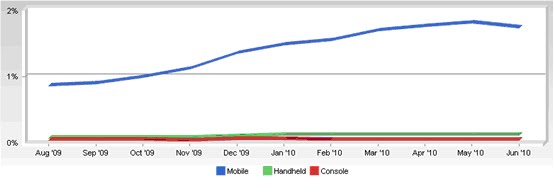
According to “Browsing by Device Category Trend” from “Netmarketshare”, we can find that the percentage of browsing via Mobile is continuously on the rise which means that more and more people access the web pages through mobile devices
Browsing by Device Category Trend
August, 2009 to June, 2010

Marketers foresee the potential of mobile marketing and they are now paying more attention and efforts on it. Other then SMS and MMS, some marketers may promote their brands by providing the useful application platform to mobile users which is free of charge, such as Google Apps. These free mobile applications help to communicate and engage with the customers in an interactive way via mobile device. For instance, Google, has launched the new smart phone “Nexus-One” in Jan 2010. Later, Yahoo has also announced to launch its first mobile phone in Asia in the coming quarter.
In general, mobile marketing is an effective and inexpensive way for promotion in recent year.
source:
http://spd4290-09817481s.blogspot.com/2010/07/mobile-marketing-evolution.html